
Spoleto Coast to Coast
A city with an ancient history, one of Umbria’s main tourist centers thanks to its archaeological and artistic monuments, a glimpse of culture and nature, where music, art, and the past meet and transform to enthral and amaze its visitors, generation after generation… all this is Spoleto.
Spoleto is just a holiday for the soul. – Gian Carlo Menotti
Whato to visit
Before starting our journey, it’s a good idea to make a list of the 10 must-see things in Spoleto. This will help you decide what to add and what to remove from the itinerary we’ll later suggest, and it will also give you a sense of what this city has to offer, at least in part.
Ok, lets go!
1. The Duomo
The Cathedral of Santa Maria Assunta, commonly called “the Duomo,” is the main church of the city as well as its most iconic monument. It is easy to understand why.
The Duomo, built between 1151 and 1227, is a masterpiece of art and architecture. Its Romanesque façade rises on the large square, which also hosts other important points of interest such as the small Teatro Caio Melisso and Casa Menotti, as well as the famous Bar of Don Matteo, Tric e Trac.
Inside, there are artworks and frescoes by important artists for the territory and the early Renaissance period, such as Filippo Lippi (Florence, June 23, 1406 – Spoleto, October 9, 1469) and his cycle “Stories of the Virgin” (1466-69) within the apse.
The view from the staircase of Via Saffi enhances the appreciation of this monument of inestimable value and its simple, sacred beauty.
Entrance to the cathedral is free. To book a guided tour of the Duomo and the Diocesan Museum with the adjoining Church of Sant’Eufemia, visit the website: https://www.duomospoleto.it/info.html.


2. The Fortress and the Bridge
At the top of Sant’Elia Hill stands the Rocca Albornoziana, another imposing symbol of the city, admired especially from its two entrances and also at night thanks to its carefully designed lighting. Together with the Ponte delle Torri, an ancient Roman aqueduct, they form an artistic and historical duo of immeasurable value.
The Rocca is significant not only for its scenic value but also historically. The fortress was built between 1363 and 1367 by commission of the Spanish cardinal Egidio Albornoz as a papal residence during travels between Rome and the Marche. Among its notable residents was also Lucrezia Borgia, who was made regent of the Duchy of Spoleto at just nineteen years old.
Between 1817 and 1982, the Rocca was used as a prison, which caused many of its original frescoes to be lost, though some precious remnants remain, such as the Camera Pinta. With its two courtyards, six large towers, walkways, and internal exhibitions, it remains a magical place that takes visitors back in time.
You can book a paid visit to the interior and walkways at: https://www.musei.umbria.beniculturali.it/musei/rocca-albornoz-museo-nazionale-del-ducato-di-spoleto/.


The Ponte delle Torri is also a monument not to be missed. It reaches a maximum height of 80 meters and a length of 230 meters. Spanning the valley of the Tessino River, it connects Sant’Elia Hill with Monteluco and the Giro dei Condotti, a trekking route that follows the old course of the Roman aqueduct immersed in nature. Recently reopened after many years of closure due to restoration work, it can be admired in all its beauty from various panoramic viewpoints in the city. I recommend the Giro della Rocca, a walk through greenery and rocks that will take you from one of the city’s main squares, Piazza Campello, to the entrance of the Rocca and is easily accessible to all.


For a different light trekking experience, try the “Giro dei Condotti,” a walk immersed in the nature of the Umbrian mountains, easily accessible for both adults and children. It starts right at the end of the Ponte delle Torri, where the Fortilizio dei Mulini is located, and ends near the escalators of Ponzianina, two strategic points in the city (with various paths leading all the way up to Monteluco).
3. Piazza del Mercato
Although Piazza del Duomo is the most scenic and beloved by tourists, Piazza del Mercato is no less charming. This space, which was the Forum of the Roman city, hosted the city market for centuries. Today, it remains a lively and youthful meeting point of the city thanks to the bars, restaurants, shops, and beautiful buildings that overlook it. Here you can enjoy the world-champion pistachio gelato, the best pizza in Spoleto, and many typical dishes such as the indispensable porchetta sandwich.
The highlight of Piazza del Mercato is the Fountain of the Clock, which once carried water from Monteluco to the city center. The old fountain was located in front of the current fountain, which was built between 1746 and 1748. Its striking façade features an ancient clock and a monument dedicated to the Barberini family.

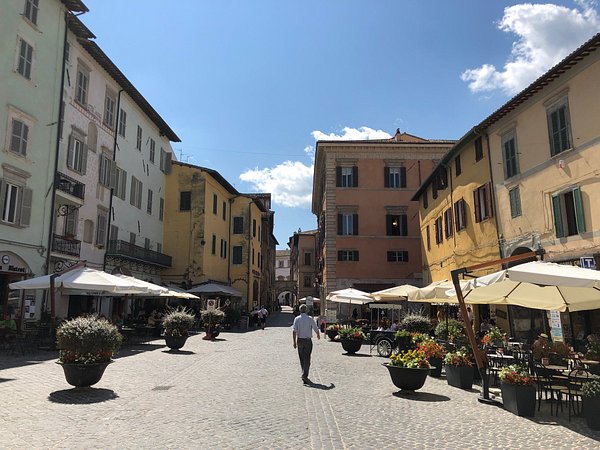


Crossing the square, take Via Arco di Druso to reach the arch that gives the street its name. This monument was commissioned by the Spoleto senate in honor of Drusus the Younger and Germanicus, sons of Emperor Tiberius. Incorporated into buildings during the Middle Ages, only one pillar and part of the arch have been uncovered. Next to the arch stood a temple approximately 12 meters high, nearly 16 meters long, and almost 9 meters wide. Today, it remains one of the main streets connecting Piazza della Libertà and Via Brignone with the Municipal Library, Piazza del Mercato, and the Town Hall.


A special mention goes to the famous Fontana del Mascherone, much loved by the people of Spoleto, located in Piazza Campello next to the start of the Giro della Rocca and in front of the monument to the fallen. It takes its name from the imposing human mask framed by laurel leaves from whose mouth water flows, allowing visitors to refresh themselves after a nice walk, thanks to the small adjacent fountain.

4. The Roman Theatre and The Archaeological Museum
Built in the first century BC, the Roman Theatre had a capacity of about 2,000 spectators and today still preserves 27 staircases on which they took their seats, the stage, and the space reserved for the orchestra and choir, still featuring colorful floors. Over the centuries, the stage area saw the construction of the Sant’Agata Complex with the church and Palazzo Corvi, but the theatre remained active and hosts shows and concerts organized as part of the Festival dei Due Mondi.
Besides during the Festival, this historical gem is fully visible from the arches of Piazza della Libertà, another main city hub from which Corso Mazzini and Via Brignone originate and which is conveniently reached by parking in the covered parking lot “Spoleto Sfera.” If you want to see it up close, it is possible with a single ticket that grants access to both the theatre and Spoleto’s National Archaeological Museum. The first floor of the museum is dedicated to archaeological evidence from Spoleto, ranging from the middle of the 2nd millennium BC to the pre-Roman phase when Spoleto became an important settlement of the Umbrian people, until the arrival of the Romans with the foundation of the colony in 241 BC and the establishment of the municipium in 90 BC. On the second floor, must-see exhibits include iron weapons found in 6th-century BC tombs. From the same necropolis comes the famous chariot covered with bronze plates, which unfortunately was taken to the United States and is preserved at the Metropolitan Museum of Art in New York.
Book your paid visit to the entire complex at the website: https://www.spoletocard.it/scheda_monumento.asp?id_circ=3


5. The Roman House and The Town Hall
In 1885 and 1886, thanks to funding from the English ambassador Sir Savile Lumeley, excavation works began on this Roman House, believed to have belonged to Vespasia Polla, mother of Vespasian, born in Norcia and owner of many properties in the territory of Spoleto. The domus dates back to the 1st century AD and over time has preserved several rooms and beautiful mosaic floors, almost entirely intact.
The Roman House is located right beneath the Town Hall, which was restored to its former glory in 2007. It deserves a visit especially for the artworks coming from the former Municipal Art Gallery, including a large canvas by Guercino and two detached frescoes by the Renaissance painter Giovanni di Pietro, known as “Lo Spagna.” Also not to be missed is the Hall of the Dukes, with portraits on the ceiling of the most important Lombard dukes of Spoleto, and the Caput Umbriae Hall, with decorations highlighting the most illustrious citizens of Spoleto through the ages. The palace also has an internal chapel dedicated to Saint Ponziano, patron saint of the city.
Book your paid visit to the Roman House (the Town Hall is currently not visitable) https://www.spoletocard.it/scheda_monumento.asp?id_circ=1


6. San Ponziano, San Salvatore and San Pietro
San Ponziano, patron saint of Spoleto, has a church with an attached monastery located just outside Spoleto, near the Church of San Salvatore. According to legend, Ponziano was persecuted by the Romans during the reign of Marcus Aurelius for being a Christian. When brought to the Spoleto amphitheater (currently not visitable), the lions refused to attack him; walking on burning coals left him unscathed; imprisoned without water or food, he was saved by angels. Only beheading could kill him (see Ponte Sanguinario), and his head rolled to the site of the current church, creating a spring of very pure water. Immediately declared a saint, Ponziano was named patron of Spoleto. He is believed to protect Spoleto from earthquakes because an earthquake happened during his martyrdom and another on January 14, 1703 (the day his feast is celebrated), which affected Abruzzo and other Umbrian cities but caused no damage to Spoleto. A prophecy is attributed to him saying, “Spoleto will tremble but will not collapse.”
The current church was built between the 11th and 13th centuries in Romanesque style, although only the façade remains from that period. In 1788, the young Roman architect Giuseppe Valadier renovated the interiors in the Neoclassical style. The church has always been accompanied by a monastery that has housed both men and women. Since 1905, it has been home to a community of Lateran Augustinian nuns who also guard the skull of the martyr saint.
Curiosity: The skull of San Ponziano is carried in procession from the church to the Duomo every January 14, where it remains on display until the following Sunday. During those days, the people of Spoleto do not cut bread with a knife to avoid imitating the executioner’s act who killed the saint.


Just a few meters from the Church of San Ponziano is the Church of San Salvatore, the oldest in Spoleto and a UNESCO World Heritage site as one of the Lombard power sites in Italy alongside Benevento, Brescia, Campello sul Clitunno, Monte Sant’Angelo in Gargano, and Cividale del Friuli. The basilica is a paleochristian building constructed entirely with spolia materials, that is, taken from other ancient constructions.
Its origin is funerary, built for the martyrs Concordio and Senzia, buried nearby and both believed to have healing powers (in reality, it was the water of Colle Ciciano that had healing properties). Later, during the Early Middle Ages, it was dedicated to the Savior, Christ, due to the crucifixion representation above the altar. The church has three naves and is now stripped of almost everything except stuccos on the counter-façade and some elements of the painted decoration in the apse. This has not deprived it of the atmosphere that makes it extraordinarily beautiful and dramatic.
For visiting the three churches (San Ponziano, San Salvatore, San Pietro):
https://www.spoletocard.it/scheda_monumento.asp?id_circ=13
https://longobardinitalia.it/basilica-di-san-salvatore/
https://www.spoletonorcia.it/parrocchia-dei-ss-pietro-e-paolo-in-spoleto/


The last gem of this spiritual triptych is located at the southern entrance of Spoleto, at the foothills of Monteluco, along the ancient “nova” variant of the via Flaminia which led to Rome. A grand and imposing 17th-century stairway immediately catches the eye; at the top rises like a temple the magnificent basilica of San Pietro known as “extra moenia,” meaning “outside the walls.” Originally, the church was erected by the Spoletan bishop Achilleo at the beginning of the fifth century and functioned as a funerary site with an adjoining cemetery. Later, during the 12th century, it was expanded. This expansion is where the wonderful Romanesque-style white marble bas-reliefs adorning the façade come from. The impact is exceptional.
These bas-reliefs narrate the life of Saint Peter, rules of conduct for good Christians, and various other stories forming a sort of “Bible for the poor.” Interpreting the stories, sculpted on church façades or frescoed inside, was the most effective and direct way to educate and reinforce the Christian message among the common people, who were mostly illiterate.
Curiosity: While walking the previously mentioned Giro della Rocca, one comes across a small rugged path descending the hill, not easily noticeable unless paying attention, leading to the famous “Pope’s Chair.” According to Spoleto legend, the pope used to sit on this “chair,” which is actually a hollowed boulder, to oversee the construction progress of the Basilica of San Pietro, viewing the church through the central arch of the Ponte delle Torri.


7. Former Spoleto-Norcia Railway
And after a tour filled with spirituality, one cannot forget to refresh the physical body: for lovers of outdoor walks, trekking routes, and mountain biking, besides the already mentioned Giro dei Condotti, Spoleto offers an exciting journey through history and nature by retracing the route of the former Spoleto-Norcia railway.
The railway, which connected Spoleto with Norcia from 1926 to July 1968, has now become an extraordinary path. It winds through hills, rivers, villages, 19 tunnels, and 24 viaducts, once a remarkable engineering jewel of its time. Ideal to travel by bike or on foot (see laspoleto-norciainmtb.it), it is 51 km long, divided into four sections:
- Spoleto to Santa Anatolia di Narco: many elevation changes but truly spectacular with bridges, viaducts, and tunnels (the longest is La Caprareccia, 2 km completely dark! Don’t forget to bring flashlights).
- Santa Anatolia di Narco to Borgo Cerreto: a beautiful stretch where the railway runs alongside the Nera River for long stretches with views over villages and historic buildings.
- Borgo Cerreto to Serravalle: crosses the Triponzo tunnel, almost 500 meters long; this section leads to the Balza Tagliata gorge with two impressive limestone cliffs about 700 meters high separated by the Corno River.
- Serravalle to Norcia: through the Biselli narrow pass, it reaches Villa di Serravalle in the Sibillini National Park and arrives at Norcia Station.
Today, the starting station in Spoleto on Via Fratelli Cervi has become a museum exhibiting memorabilia, documents, parts of the railway system, objects, and photographs from the old railway.
For information on events, usability, and museum opening hours visit: https://www.umbriamobilita.it/ex-ferrovia-spoleto-norcia-indicazione-dei-tratti-percorribili-contenuti-aggiornati/
https://www.umbriatourism.it/it/-/ciclovia-ex-ferrovia-spoleto-norcia
https://www.comune.spoleto.pg.it/turismoecultura/musei/museo-della-ferrocia-spoleto-norcia/


8. Collicola Palace Visual Arts
Not only an immersion in nature, history, and sacredness, Spoleto is also an important reference point for art. An example is the 18th-century Palazzo Collicola, located in Piazza Collicola in the city center, which hosts a vast collection of visual art including works by painters and sculptors from the 12th century to the present day.
Palazzo Collicola is one of the most important noble buildings in Spoleto, built by the noble family from which it takes its name, originally from Montesanto di Sellano, which rose to prominence in the 17th century thanks to Taddeo, physician to Pope Urban VIII. The imposing building was constructed between 1717 and 1730 to a design by architect Sebastiano Cipriani, who conceived a three-story facade extended at the rear by two wings that originally bordered the Italian-style garden.
On the noble floor, among the many rooms it comprises, of particular value are the Gallery, entirely decorated with 18th-century tempera paintings, and the Chapel, inside which precious liturgical furnishings are kept. Some rooms host a picture gallery with paintings from the 16th to the 19th century, including the famous Pharmacy from the workshop of Guercino and a Still Life attributed to the Master of Hartford.
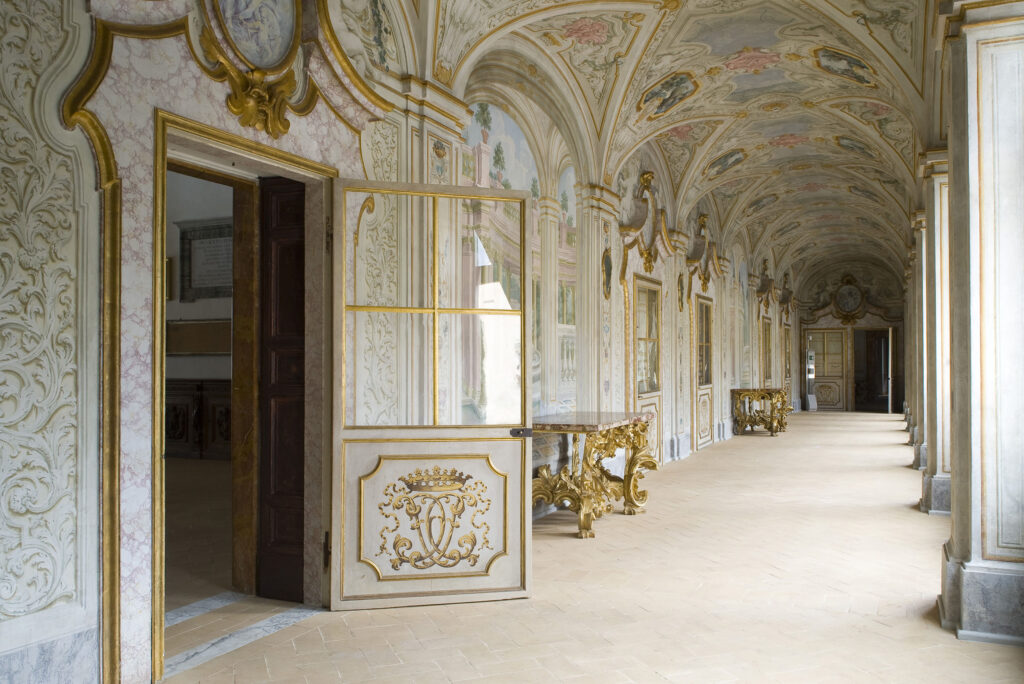


Here is the complete English translation of the text about Palazzo Collicola and the Carandente Museum: The museum was opened in 2000 and, together with the Library located on the noble floor, is named after Giovanni Carandente, a famous art critic who over the years donated not only monographs, catalogs, and periodicals but also a substantial amount of archival documentation and numerous works of art.
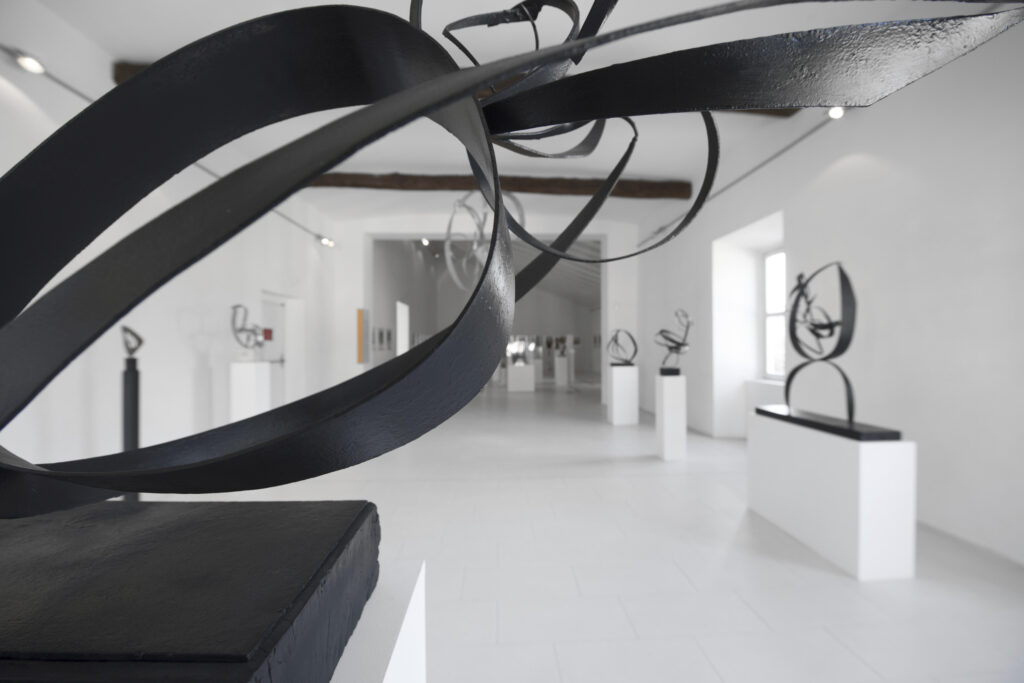
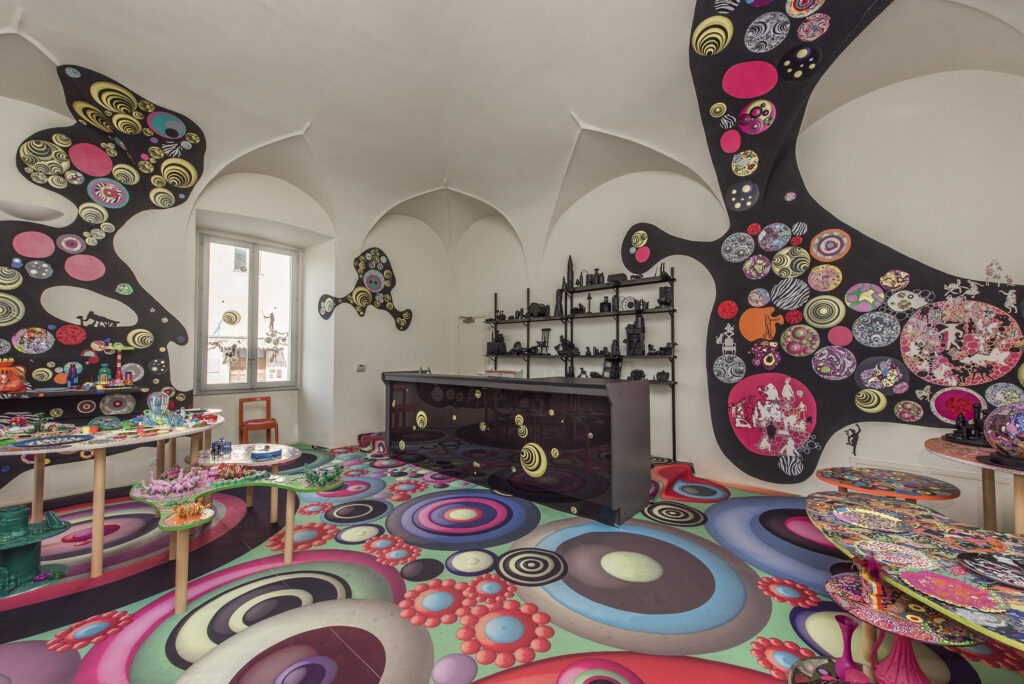
The museum is spread over three floors and houses works of every kind, style, form, and era, divided into thematic, monographic, stylistic, and historical rooms. The collection includes not only paintings and sculptures but also photographs, street art, and various installations. Organized into 18 rooms, the museum boasts works by Calder, Pepper, Moore, Smith, Pomodoro, Burri, Consagra, Pascali, Accardi, and LeWitt, making it one of the most important contemporary art collections in Italy. All these works, especially the more modern ones, create a fascinating contrast with the 18th-century interiors of the palace, making the museum itself a work of art to experience.
Aperta al pubblico nel 2006, la Biblioteca Carandente è costituita da una sala di studio e lettura, una sala per piccole conferenze e alcune stanze di deposito librario.
Il patrimonio conservato nella sala studio raccoglie oltre 30,000 volumi ed è liberamente accessibile all’utenza, interamente catalogato e pertanto reperibile attraverso i cataloghi online.
Per informazioni sugli eventi, i tour guidati e gli orari di apertura del museo: https://www.palazzocollicola.it/biglietteria.asp



9. Mauri Palace
We continue our tour with another important palace of another influential family of Spoleto. Facing Piazza Pietro Fontana, which was built on the site of a private garden and is characterized by a fine 16th-century fountain and some Roman-era relics, and at the end of Via Arco di Druso, stands Palazzo Mauri, a noble residence from the 17th century.
The palace belonged to the noble Mauri family, and it was Andrea Mauri—General Prefect of Posts and Customs under the pontificates of Pope Paul V and Urban VIII—who was responsible for the construction and decoration of the Spoleto palace.
The Roman environment frequented by Mauri, between the Borghese and Barberini families, greatly influenced the artistic taste and choices for commissions in Spoleto, which, in addition to the palace, include a chapel inside the Spoleto Cathedral. The chapel was inaugurated in 1626 when Mauri had also completed his “Roman-style” palace, possibly by the same architect.
At Mauri’s death, the fresco decoration of the new palace was already finished, as demonstrated by the dates placed by the painters on the ceiling of the Bird Room (1622) and, together with their signatures, on the frescoes on the ceiling of Phaethon (1622) and the Justice Room (1625).
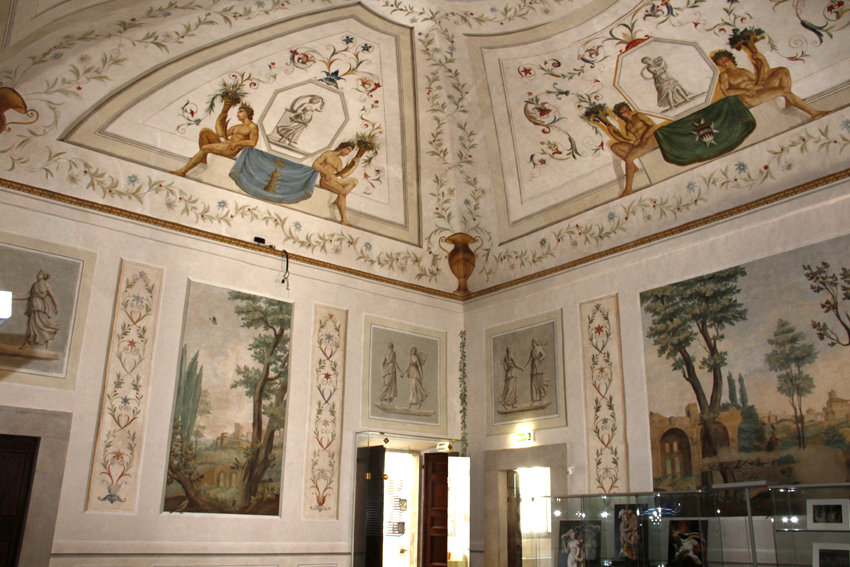
Completely renewed and restored (2009), the building has recovered the functionality of the rooms and the beautiful decorations of the representative halls attributed to painters Alessandro Bottoni (17th century), Giuseppe Valeriani, and Domenico Sergardi (18th century), well-known and active locally.


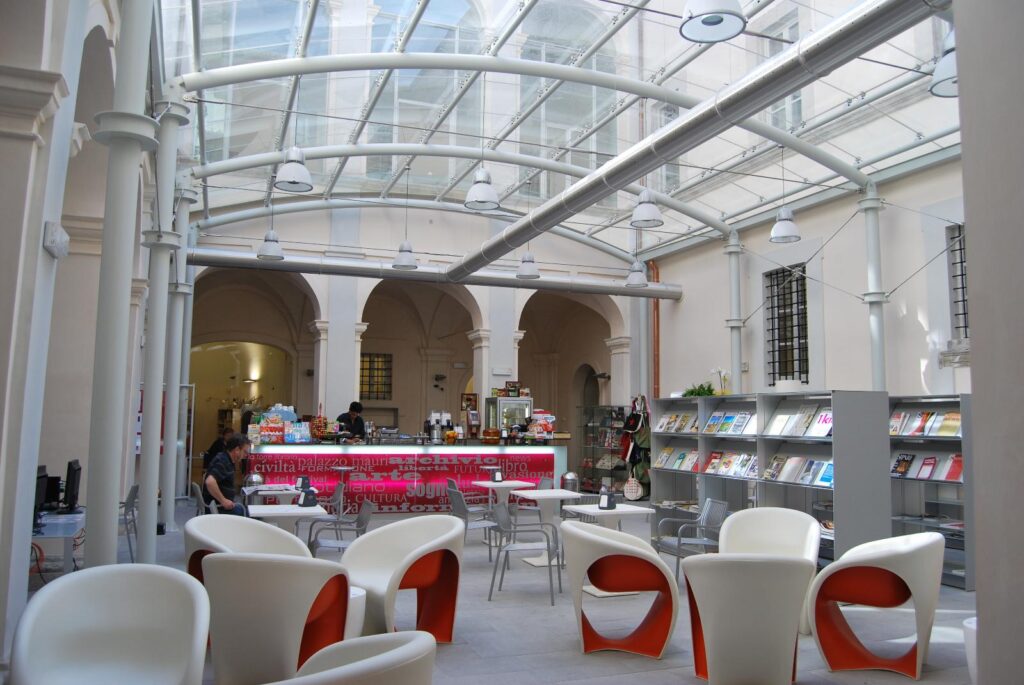
In the inner courtyard of the palace, protected by a transparent roof, a Literary Café has been created (currently not functioning), with a newspaper library service and internet access point, also used for concerts, meetings, and readings. In the Café premises, one can admire an interesting 6th-century mosaic uncovered during restoration works. This discovery enriched the understanding of the complex urban stratification of the city, situated near the area that in Roman times was destined to the Forum, which underwent transformations in the Lombard period.
The palace now houses the ‘G. Carducci’ Municipal Library, which includes a substantial collection of ancient books. The public spaces are spread over three floors (approximately 2,200 square meters). The brand-new Municipal Library also features a playroom and a rich Multimedia Section. The ground floor houses the Children’s Section and the playroom, offering diverse stimuli and suggestions for the younger audience. The upper floors hold the lending and reference areas as well as reading and study rooms, all equipped with computer stations connected to the network, where part of the modern book collection is shelved openly, organized by disciplinary or thematic areas.
The documentary heritage amounts to approximately 110,000 units, including volumes, pamphlets, magazines, manuscripts, and prints, around 19,000 of which belong to the Ancient Collection. Added to this is the documentary heritage of the Multimedia Documentation Center of the City of Spoleto, consisting of about 50,000 pieces including photographic prints, slides, negatives, photographic plates, postcards, and films.
For information on events and library opening hours, visit: https://www.comune.spoleto.pg.it/turismoecultura/la-citta/biblioteca-giosue-carducci-a-palazzo-mauri/biblioteca-comunale-giosue-carducci/

10. The Oil Tower
We conclude this tour of sights in Spoleto with the historic Torre dell’Olio. As is well known, many towns in central Italy were characterized by the presence of numerous towers. Spoleto is no exception, and the Torre dell’Olio, dating back to the medieval period, at 45.5 meters tall, is the highest tower in the city. Its name comes from the fact that in the past, to defend against enemies, boiling oil was poured from the top. It is said that even Hannibal with his elephants and troops was subjected to this treatment during their march to conquer Rome. For this reason, the street right beneath the tower is called Via Porta Fuga and is enhanced by a large stone gate with an inscription commemorating this event.


The tower is a very significant historical testimony and can only be admired from the outside by passing through one of the main streets of the city that connects the new part with the historic center, Corso Garibaldi, known in Spoleto dialect as Borgo. It starts from Piazza Garibaldi, which is also surrounded by important monuments such as the Church of San Gregorio and the Obelisk, and passing through Corso Mazzini, reaches Piazza della Libertà and Piazza del Mercato. It is a pleasant walk to admire Spoleto with its alleys and local shops and serves as the starting point for our itinerary…
One-Day Itinerary
Before starting our itinerary, a premise is necessary: to fully visit Spoleto, one day is not enough. Indeed, beyond the 10 things listed above, there are many more worth exploring, and with more time available, you avoid rushing to see everything and have the opportunity to visit the interiors of various museums and monuments, which this itinerary does not include (a list of other interesting points worth dedicating time to). I recommend at least three days, a nice weekend, or a long cultural and discovery break.
Starting points: there are multiple optimal starting points, though this does not affect the order of our itinerary. I considered those closest to convenient parking and alternative mobility services.
- Piazza Garibaldi (walk to the escalators on Via Ponzianina and take the elevators at the end of the escalators)
- Spoleto Station (walk along the station avenue – Via Trento e Trieste – reaching the escalators on Via Ponzianina and take the elevators at the end)
- Spoleto Sfera (walk to Piazza della Libertà, continue through Via Brignone to Piazza Campello)
- Posterna Parking (take the moving walkways and exit at the last stop)
Rocca Albornoziana and Giro della Rocca: Starting from one of the above points, I recommend proceeding on foot or using the escalators/moving walkways toward the city’s first panoramic viewpoint, the Rocca. From now on, the rest of the journey will be downhill — essential to best handle this city that has many elevation changes. The two alternative mobility routes are efficient and connect all main city points easily, so I suggest using them at least to reach the first itinerary point. Upon arrival at the Rocca, take a relaxed walk around the Rocca circuit and reach the second point.
Ponte delle Torri: Continuing the Rocca circuit leads easily to the recently reopened and walkable bridge. I suggest looking out from the window overlooking the valley and the beautiful Church of San Pietro, then return and finish the circuit. At this point, you will find yourself in Piazza Campello with the Mascherone fountain for some refreshment.
Duomo: Descending the small stairs ahead, you will follow the main street leading to the Duomo, which you will find to your right after some meters. Stop to admire the beautiful staircase leading to the large square, and if you want to visit inside, descend the spacious steps (following this itinerary, you will also pass several famous places from the Don Matteo series, such as the Captain’s and Cecchini’s houses, the canonry, and the Church of Sant’Eufemia).
Piazza del Mercato: Ascend the staircase again and continue along Via Aurelio Saffi to reach a large arch and the market square. This is also a good time for a lunch break. Here you have many options with typical products, pizzerias, and chic restaurants. For a quick meal, I recommend Pizzeria dell’Orologio, da BiBi (Spoleto’s best pizza by the slice). For a taste of local cuisine, I’d opt for La Bottega (sandwiches), Il mio Vinaio, or Il Tempio del Gusto (restaurants). There are also many shops to purchase local products and bring home a small taste of Umbria. The choices are many!
Teatro Romano: After your break, proceed along Via Arco di Druso and Via Brignone. You will pass the Municipal Library (if you want to stop for a brief free visit, check opening hours carefully) and reach Piazza della Libertà. Here you will find a lovely panoramic point overlooking the Roman Theatre from above (if you have time and interest, this is a good moment for a guided tour of the theatre and the adjacent Archaeological Museum).
Corso and Borgo: From here, continue with a pleasant walk along Spoleto’s two main streets, Corso Mazzini and Corso Garibaldi (Borgo). Along these streets, there are many nice shops for souvenirs or quality keepsakes, as well as points of interest such as the Archaeological Museum and the Museum of Textiles and Costume (MUTEC). Upon arrival at Piazza Pianciani, you will find a beautiful recently restored staircase and behind you the Church of San Filippo. Near the bank Cassa di Risparmio dell’Umbria are small stairs continuing our route. At the end of the small street, on the corner, is one of Spoleto’s oldest and most renowned bars, Tebro. No one can take away a nice hot chocolate break from you. To your left, you will find the Teatro Nuovo Giancarlo Menotti. Continuing along the pedestrian route, you will reach Via Porta Fuga and the Torre dell’Olio.
Walking through the entire Borgo, you end up right at Piazza Garibaldi! The tour ends here, but many things remain to be seen! I leave you with a small downloadable map with the itinerary traced and main points of interest highlighted.
Also consult the two boxes for useful information and small additional tips. Feel free to contact me for any doubts or curiosities…
Thank you very much for your attention. At this point, I can only wish you a good trip and a pleasant stay!!
#1dayitinerary
